
On this day in 1969, Apollo 11 Astronauts Neil Armstrong, Buzz Aldrin, and Michael Collins completed the first-ever landing on the Moon. While Collins circled the Moon on the Command Module (aka “Columbia”), Armstrong & Aldrin spent over 21 hours on the lunar surface’s Tranquility Base alongside the Module (aka “Eagle”). Though most Apollo mission patches featured the Astronauts’ names, the A11 crew decided not to include their names so the patch would represent “everyone who had worked toward a lunar landing.” As Neil Armstrong later said: “We had hundreds of thousands of people dedicated to doing the perfect job.” This particular Apollo 11 patch, pictured above, was flown on the mission, signed by the crew, and later given to NASA in 2014 for safekeeping until it can be presented to the first crew to land on Mars. (Photo: NASA)
Packing for the Moon

On July 16, 1969, Astronauts Neil Armstrong, Buzz Aldrin, and Michael Collins launched into space aboard Apollo 11, beginning a multi-day journey to the Moon which culminated in the historic Tranquility Base landing on July 20, 1969.
All three Astronauts were given a small bag (known as a “PPK” or “personal preference kit”) for personal items of significance weighing no more than .5 pounds in total. For his LM (Lunar Module) PPK, Armstrong chose several items including a 4” x 6” silk American Flag and original piece of wing fabric from the Wright Brothers’ historic “Wright Flyer.”
Fun fact: the legendary “Wright Flyer” was the first successful flying machine, built by Orville and Wilbur Wright. It flew four times on December 17, 1903 in Kitty Hawk, North Carolina. Orville flew first: covering 120 feet while staying aloft for 12 seconds. (Photo: Cosmosphere)
The Historic Odyssey

On April 11, 1970, Astronauts Jim Lovell, Fred Haise, and Jack Swigert climbed aboard the Apollo 13 Command Module (CM) (aka “Odyssey”) and launched from Kennedy Space Center in Florida. Two days into the flight, on April 13th, Apollo 13 was aborted after an oxygen tank ruptured on the way to the Moon.
Later deemed a “successful failure” because of experience gained in rescuing the crew, Apollo 13 became a landmark example of how teams can work together to achieve success under tremendous pressure.
Fun fact: the Cosmosphere’s SpaceWorks division worked on the restoration of the Apollo 13 Odyssey spacecraft, and also built historically-authentic spacecraft and mission control replicas for Ron Howard’s classic movie “Apollo 13” starring Tom Hanks. When asked about the film, Howard stated that it’s one of his favorites: “Every time I see it on TV, I have to watch it all the way to the end. It’s such a great story.”
The Cosmosphere is proud to display the authentic, flown Apollo 13 Odyssey spacecraft, along with the actual spacesuit worn by Commander Jim Lovell during the voyage. This suit was the A7L-version of the Apollo LEVA (lunar extravehicular activity) space suit, and was the first to incorporate red stripes to identify the mission commander...a practice still in use today. (Photo: Cosmosphere)
Liberty Bell 7: Splashdown!
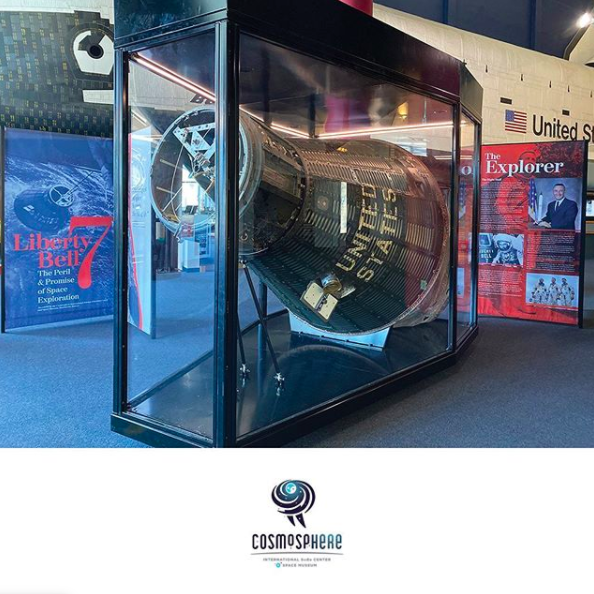
Virgil “Gus” Grissom (Lieutenant Colonel, USAF) became the second American to fly into space…and his Mercury spacecraft is now on display at the Cosmosphere in Hutchinson, KS, through the end of 2020!
On July 21, 1961, Grissom launched aboard the Mercury-Redstone 4 (aka “Liberty Bell 7” or LB7) from Cape Canaveral, Florida. After an historic and successful 15-minute suborbital flight, the splashdown of LB7 became a story of survival. Once in the water the hatch of the spacecraft malfunctioned and the craft quickly filled with water. Grissom fought for his life as helicopters tried to save LB7. Grissom was rescued, but sadly after many attempts at recovery, LB7 sank to the bottom of the Atlantic Ocean, where it was recovered in 1999. During the restoration process (which was completed by the Cosmosphere), technicians found a treasure trove of artifacts including a signal mirror, dollar bill, and a bar of Dial soap…still in the package.
Fun fact: the Mercury-Redstone name refers to the Mercury capsules, which were launched atop Redstone rockets. Each Mercury Astronaut followed the pilot’s tradition of naming their aircrafts, and included the number “7” on each selection to commemorate the original 7 Astronauts. Grissom named his spacecraft LB7 after to the capsule’s bell shape, and “Liberty’s” synonymous meaning to the word freedom. As an homage to the original Liberty Bell, the spacecraft included a “crack” painted on the side.
This week, plan your 4th of July Staycation at the Cosmosphere! Experience spectacular stories of achievement in U.S. history by getting up close and personal with REAL spacecraft and artifacts. This week, we’re featuring stories about our new X-Plane Gallery, Liberty Bell 7, Apollo 13 Odyssey, and newly displayed artifacts from the personal collection of Neil Armstrong. (Photo: Cosmosphere)
Faster than the Speed of Sound

On October 14, 1947, U.S. Air Force General Charles “Chuck” Yeager became the first pilot to fly faster than the speed of sound.
Flying in the Bell X-1 rocket engine-powered aircraft (nicknamed Glamorous Glennis after Yeager’s wife), Yeager dropped the plane from the bomb bay of a B-29 — and achieved supersonic flight over Rogers Dry Lake in the Mojave Desert. In “the most historic ride since the Wright Brothers,” Yeager reached Mach 1.06 (700 mph) at an altitude of 45,000 feet. Fun fact: the “Mach” number, or the ratio of one’s speed to that of sound, and was named after physicist Ernst Mach, who photographed an object moving faster than the speed of sound in 1887.
The Cosmosphere is proud to display this replica of “The Orange Beast” from the Oscar-winning film “The Right Stuff” in our new X-Plane Gallery. And check-out the XLR-11 rocket engine which propelled the Bell X-1 into history, and an XMC-2 spacesuit worn by test pilot (and shuttle Astronaut) Joe Engle on the X-15…which he flew above 266,000 feet. (Photo: Cosmosphere)